Florida’s two-day spiny lobster sport season—better known around the Keys as “mini-season”—is a memorable way to get on the water, but it is not a casual free-for-all. Rules are closely enforced, protected areas are extensive, and a simple measuring mistake can turn a fun day into an expensive one. The next scheduled sport season is July 28-29, 2027; it is held on the last consecutive Wednesday and Thursday of July each year. Always check current details before you go, particularly if you are booking a charter or traveling with a boat.
Start with the right license and lobster permit
Unless an exemption applies, every person who will take or attempt to take lobster needs both a Florida recreational saltwater fishing license and a spiny lobster permit. This applies to visitors as well as Florida residents, and it applies to swimming, snorkeling and diving—not just fishing from a boat.
- A nonresident saltwater license costs $17 for three days, $30 for seven days or $47 for an annual license.
- The annual spiny lobster permit is $5 for residents and visitors.
- Children younger than 16 are exempt from the license and permit requirement, but they must be actively harvesting to have their own bag limit.
Do not count a non-harvesting friend, child or passenger toward the group total. Every lobster in the boat must belong to an individual who is legally eligible and actively participating. If you are joining a for-hire trip, ask the operator before booking whether its licensing arrangement covers your fishing license and whether you still need an individual lobster permit.
Sport-season limits: Keys vs. the rest of Florida
The sport-season bag limit is six spiny lobster per person per day in Monroe County, which includes the Florida Keys, and in Biscayne National Park. Elsewhere in Florida, the sport-season limit is 12 per person per day. On the water, your possession limit is the same as that day’s bag limit.
There is a narrow two-day carryover allowance on shore: on day one, the off-water possession limit remains one daily bag limit; on day two, it becomes double the daily limit. In the Keys, that means no more than six per person off the water after the first day and no more than 12 after the second. The regular recreational season runs August 6 through March 31, with a six-lobster daily limit statewide.
Measure before you keep
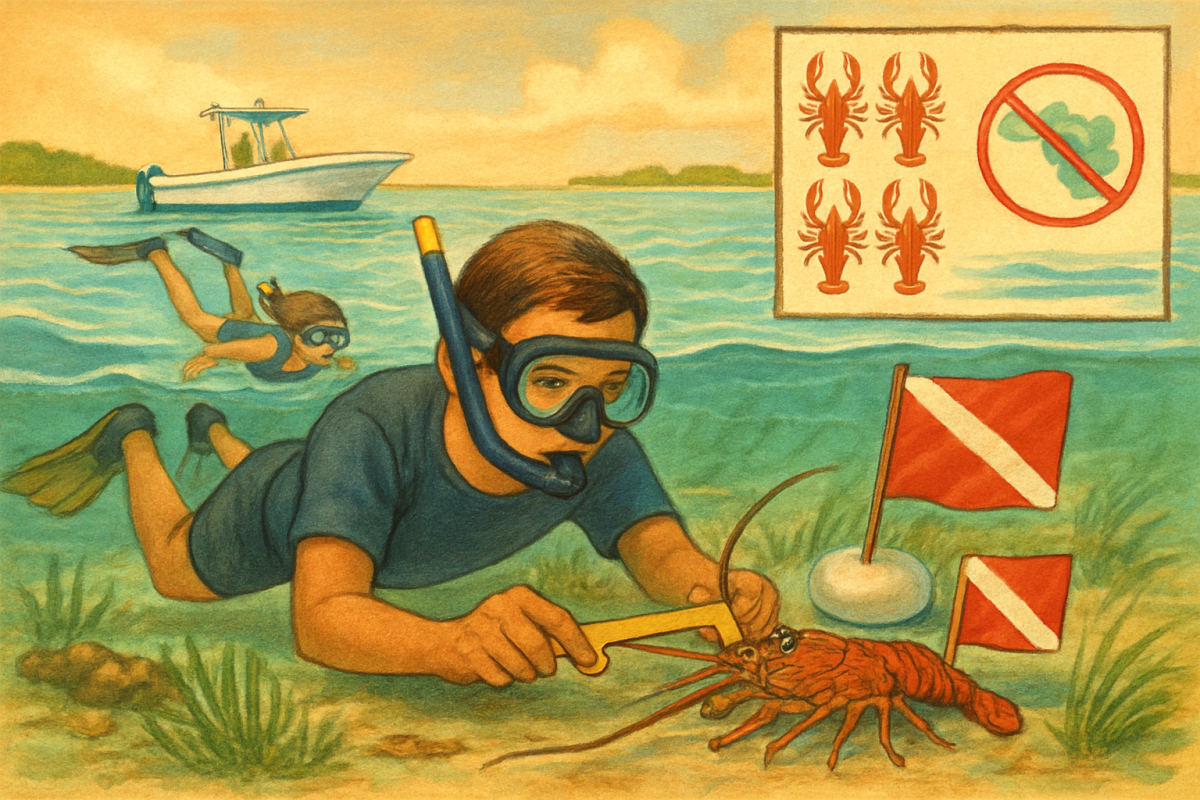
A legal spiny lobster must have a carapace—its hard upper shell—larger than three inches. The measurement runs from the front edge between the horns straight down the center of the shell to its rear edge. It must be measured in the water, before it comes aboard or goes into a catch bag.
Carry and use a dedicated lobster carapace gauge every time you hunt. A lobster exactly three inches is not legal; it must be longer than three inches. Egg-bearing lobster cannot be kept, and lobster must be landed whole—separating the tail from the body in Florida state waters is prohibited.
Legal gear—and what stays home
Recreational harvest is limited to hand collection and simple hand gear. Landing or dip nets are allowed, as are bully nets up to three feet in diameter and hoop nets up to 10 feet in diameter. Recreational traps are not allowed. Neither are hooks, spears, gaffs or any tool that could puncture, crush or penetrate a lobster’s shell or flesh. Bleach and other chemical solutions are prohibited, and harvesting from an unpermitted artificial habitat is illegal.
In the Keys, do not overlook dive-flag rules. A diver or snorkeler needs a proper flag, and vessels must slow to idle speed/no wake within 300 feet of a displayed divers-down flag. A highly visible dive flag float is basic safety equipment, not an optional accessory.
Where lobster harvest is prohibited
Florida Keys visitors need to plan around closed water, not simply navigate toward the nearest reef. During sport season, lobster harvest is prohibited throughout John Pennekamp Coral Reef State Park. Year-round closures include Everglades National Park, Dry Tortugas National Park, the Biscayne Bay/Card Sound Lobster Sanctuary, and five Coral Reef Protection Areas within Biscayne National Park.
In the Florida Keys National Marine Sanctuary, no-take zones are closed to lobster harvest year-round. Sanctuary preservation areas and conservation areas are generally marked by large yellow boundary buoys, but do not rely on seeing a buoy at the last minute: review the sanctuary zone map and load the boundaries into your navigation app before departure. Some zones have special access or boating restrictions in addition to the no-harvest rule.
Extra Keys visitor rules to remember
Night diving is prohibited in Monroe County during sport season; for this rule, “diving” includes swimming at or below the surface. Monroe County also regulates certain snorkeling and diving activity around mini-season, so shore-based visitors should confirm local restrictions and access conditions before heading out. Public ramps and parking fill early, and some county facilities charge nonresidents special mini-season entrance or ramp fees.
Practical takeaway: Buy licenses and permits in advance, carry a gauge and dive flag, study protected-zone maps before launching, and treat six as the hard Keys limit—not a target to stretch.